
Throughout my entire travels, one accolade that had still been eluding me was to get up and close to a bona fide iceberg. In fact, prior to summer 2008, any sort of "Arctic experience" I had was virtually non-existent. The exceptions being maybe strolling through streets in the midnight sun of St. Petersburg, or a trip through Sweden's southern region of Scania. However, this hardly constitutes for an 'Arctic adventure'. While I'd always fantasized about making the icebreaker vessel journey through Antarctica, the costs and seasonal dilemma has always rendered this plan to nothing but a personal reverie. Greenland however, being only a short two hour flight away from Reykjavik, Iceland was a much more realistic and accessible destination to see icebergs. With both Iceland & Greenland being destinations I had been intrigued about for quite some time, it wasn't before long that I had my Lonely Planet Guides, flight bookings and was ready to go.
I came across the idea to go to Greenland rather accidentally. I was surfing the Internet one day, searching for photos of icebergs for an exercise I was developing on Antarctica for my students, when I came across the Flugfélag Airlines (aka Air Iceland) website advertising 'day trips' to Kulusuk, a tiny village located on an island just off the east coast of Greenland. Although, I'm not one for guided day trips, I realized that this was a unique opportunity to 'kill two birds with one stone', as the intriguing volcanic hotspot island of Iceland was another destination on my 'countries-to-do list'. So, after some articulate planning, I booked flights on 3 separate tickets online: Abu Dhabi-London via British Airways, London-Reykjavík (Keflavik) via Icelandair and then Reykjavík-Kulusuk via Flugfélag Airlines.

As stated earlier, Iceland was always a place that I'd wanted to visit. This unique geothermal-powered island offers plenty for the adventurous independent traveler. There's the requisite tourist sites: the 'Golden Triangle', which includes Europe's largest waterfall Gulfoss, Geysir - the world's most consistent geyser and the Pingveller National Park. Traveler can also enjoy hiking through Iceland's unique volcanic landscape, walking ontop of some of the world's largest glaciers through ice caves and crevices, participating in the 'runtur' - the traditional Icelandic pubcrawl and exploring the quirky capital city Reykjavik, soaking in the waters of the world-renowned geothermal hot spring of Blue Lagoon, whale or puffin watching, scuba diving along the volcanic rift, etc. This tiny island really has it all. With exception to the diving, in my short time in Iceland, I managed to pull in all of the aforementioned activities.
Iceland is also noted to be one of the world's most intellectual societies. Reykjavik apparently boasts the largest number of newspapers per capita. Icelanders are liberal-minded people who also supposedly enjoy one of the highest qualities of life in the world. Evidence of Icelanders love for the arts is evident walking around the nation's capital as museums, galleries and libraries are scattered on every corner. There's an active music scene in Reykjavik with local acts performing in various bars around town. Located right on the epicenter of the Mid-Atlantic Ridge, Iceland is a geological hotspot and the volcanic activity that arises from this forms the country's unique landscape. Iceland is one of the greenest countries in the world with over 70% of its energy being generated from renewable sources - most noticeably geothermal power.

Although only a short two hour flight away from Iceland, neighboring island-state Greenland seems a world away. Tunu (aka 'East Greenland'), with a landmass of 1,457,000 km² and a population of only 3,800 people (that's 0.0026 persons/ km²), East Greenland is about as isolated and remote as you can possibly find. However, about half of that population resides in Tunu's administrative capital, Tasilaq. Tasilaq's picturesque setting, on a bay surrounded by mountains and fjords, means it is bereft of the requisite flat space needed for an international airport. For this reason the region's airport is located at nearby village of Kulusuk.
One popular way to see Greenland is through packaged tours on Air Iceland from Reykjavik. There are day-tripping tours as well as others that offer a couple of nights accommodation in Greenland. While these may be the easiest and most financially practical way of experiencing Greenland, these stop-and-go packaged tours are, in my opinion at least, unadvisable as in Greenland the weather dictates everything. There is no guarantee whether or not conditions will permit traveling by certain land, sea or air routes. Shorter excursions, such as succint iceberg cruises and local hikes are usually doable. However, to really see Greenland, longer, more adventurous and drawn out excursions are required but may not always be guaranteed to depart on their scheduled dates. I had to wait around several days for the Knud Rasmussen Glacier trip. The wait was certainly worth it though as I'd rank that particular trip amongst some of my all time favorite traveling experiences. It was not only the glacier itself but the entire boat ride through the iceberg and whale filled fjord that made the trio so special. The moral of the story is that patience is a virtue one must pack in their rucksacks when traveling in this part of the world.

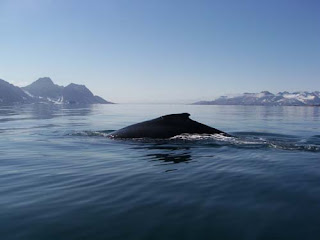
In the end, gorgeous Greenland turned out to be quite a difficult place to leave behind. Was it the breathtaking views of tranquil crystal blue water meandering through the ice-filled fjords, or perhaps the tantalizing humpback whales who would surface and dance majestically from the depths of the ice cold ocean, as if perfectly choreographed specifically for the awestrawk admirers and cameras waiting at the surface? Was it the magnificent, gargantuan picture-perfect icebergs that rose up like state of the art ice structures as if on display at an avant-garde architectural conference? Well that too….. But when I say that Greenland was a difficult place to leave, I mean just that … it actually was a difficult place to leave. The reason for this is that in Greenland, weather dictates everything, especially when it comes to traveling. When heavy fog roles in, the runway in Kulusuk becomes practically invisible to incoming planes and it's not that rare for all incoming and outgoing flights to be canceled for and entire day - if not more.
This is exactly what happened on the day I was due to fly out. I wound up having one day extra in Greenland and inevitably missed all my connecting flights. Airlines nowadays are not responsible for flights missed due to 'acts of god' and I guess heavy fog is deemed out of Air Iceland's control. Fortunately Air Iceland was able to reschedule a flight back to London with Icelandair at no charge, and I was also able to reschedule my British Airways flight back to Abu Dhabi with little difficulty. The experience though does show how volatile plans can be in Greenland and the need to bring plenty of time and patience along with your Danish kroner in Greenland.
Speaking of kroner, which is used both in Iceland & in Greenland (Iceland uses Icelandic kroner and Greenland uses Danish kroner) - bring plenty of it as neither Iceland nor Greenland are cheap destinations. In fact, the terms 'Iceland' and 'expensive' seem to be synonymous with each other. Iceland is notorious for being outrageously overpriced and I had previously read that back in the days before the widespread use of mobiles and Internet, the world's most expensive phone call was from Reykjavik to Tokyo at peak hours. With the going rate for a bed space in a hostel, bedding not included, at around US$50/night, I'm not going to try and dispute that claim. With virtually everything having to be imported from abroad, Iceland is not exactly a budget traveler's paradise. Sitting down in a restaurant in Iceland would cost about a months salary in some parts of the world and transportation is another pocket drainer. The round-trip bus pass from Reykjavik to Skaftafell (about 6 hours each way) cost almost $200! This shouldn't be too surprising however, considering the bus is running on some of the world's most expensive petrol.

Greenland doesn't fare too much better either. Accommodation is limited and not cheap. With the exception of overpriced hotel restaurants, there seems to be a dearth of locally-run restaurants or cafes. The main killer in Greenland is transportation. Without a network of roads connecting towns and settlements, the main method of transport is helicopter, boat or dogsled - none of which comes cheaply. I had to hire a local boatman to take me from Kulusuk to Tasilaq for over a hundred dollars. A priceless and spectacular journey in itself through massive icebergs and surfacing whales; however, given the overall distance being a mere 20km, covered in less than an hour - a little overpriced nonetheless. My original objective was to get to the western town of Ilulissat, home to Ilulissat Kangerlusa - one of the world's largest and most spectacular ice-fjords. However, when I discovered the airfare for the domestic plane ticket from Kulusuk to Ilulissat alonse was a whopping $2,500 on Air Greenland, I opted to marginalize my Greenland experience to the more accessible Kulusuk, Tasilaq and their surrounding environs.
The cost factor however should not turn you off completely from coming to Iceland or Greenland as the stories, photos and memories one brings back are priceless. Also, there are of course many ways to keep costs down. In Iceland, advanced online bookings can bring lower prices considerably for accommodation and boycotting sit-down restaurants while sticking to cafés & food stalls, and collaborative self-catering in hostels with fellow travelers will save considerably on food expenses. In Greenland, traveling with a partner or in a small group will bring down transport costs by a mile. Also, Greenland is prime-camping ground. Bringing along a tent and sleeping bag, or just renting one from the Tasilaq tourist office, is certainly a viable option.
To view the complete write up/photos of the trip, check out my main Greenland/Iceland sites:
Main site -
http://www.glennstevens.biz/greenland.htmWest Iceland -
http://www.glennstevens.biz/reykjavik.htmEast Iceland -
http://www.glennstevens.biz/iceland.htmKulusuk, Greenland -
http://www.glennstevens.biz/kulusuk.htmTasilaq, Greenland -
http://www.glennstevens.biz/tasilaq.htm
 Although many of Iceland's main tourist attractions are crammed in the southwestern corner of the country, within a hundred kilometer radius of the capital city, Reykjavik - to come all of the way to this fascinating country and only stick to the tourist hotspots of Reykjavik, the Golden Triangle and the Blue Lagoon would be a real shame. Although Iceland is by no means a large
 country, going from place to place can take a little longer than it may look on map given that most of the highways are located along the parameter. For this reason, given my time limit, which was about a week - I chose to stick to two main bases. The first of course being Reykjavik, the second being Skaftafell National Park - Iceland's largest and most popular national park. The Skaftafell base-camp is located on the southern edge of the Vatnajökull ice cap - the largest glacier in Europe by volume. Skaftafell is an excellent place for hiking within the mountains piercing the glacier. Walking on or through the glacier itself with crampons and ice-axe is another activity that can be arranged at the Skaftafell Visitor's Center. Longer hikes deep into the heart of the glacier can also be arranged.
 One fascinating and easily accessible day trip from the Skaftafell National Park is the mystic Jökulsárlón Lagoon. Due to ice breaking off the Vatnajökull glacier, the glacial lake is packed with luminous blue icebergs creating one the most picturesque places in Iceland. Scenes from the James Bond films, A View to a Kill & Die Another Day were filmed here and one feels just like agent 007 riding the monstrous boat / 4WD truck through the lake.
 Skaftafell is accessible from Reykjavik by Flybus, Iceland's premier public transport carrier. Even though a return ticket costs a whopping 150 Euros, one has to remember the buses do run off of some the world's most expensive petrol. Also, the bus ride is an adventure itself. Flybus allows tourists to make the return trip in alternative routes, one along the southern coast road via the picturesque coastal town of Vik as well as making several waterfall stops, including Sellfoss. The return bus-ride goes through tranquil inland landscape of Iceland's southern countryside via the thermal pools of Landmanlauger and the aptly named town of Kirkjubaejarklaustur, near the striking Systrafoss waterfall. These various stops certainly added an extra dimension to my Iceland experience.
 As always the full photos/write up can be accessed at my main site:


